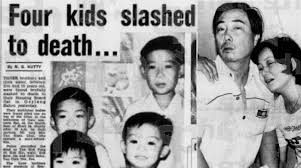
Four children. One locked flat. No answers — over 45 years later.
In 1979, Singapore was a young, rising nation — still more than a decade away from becoming the gleaming city-state the world knows today. Crime was largely petty: pickpocketing, home theft. Violent offenses were uncommon. Against this backdrop, what happened inside a one-bedroom flat in the Geylang Bahru neighborhood on the morning of January 6th was nothing short of unthinkable.
The family
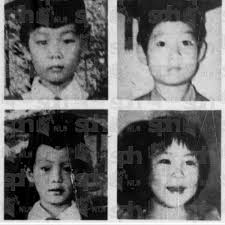
Tan Kuen Chai and Lee Meiying were working parents running a mini-bus business, ferrying schoolchildren to class each morning in the same apartment building where they raised their own four kids. The couple had settled into a steady rhythm of early mornings and tight quarters. Their children — Kok Peng (10), Kok Hin (8), Kok Soon (6), and the youngest, five-year-old Chin Nee — would wake, dress, and head to school while their parents were already on the road.
By early 1979, Meiying had undergone a sterilization procedure. The family felt complete.
The morning everything changed
At around 7:10 a.m. that Saturday, Meiying called home as she always did — a routine check to make sure the children were up and moving. No one answered. A neighbor was asked to knock on the door. Silence there, too.
When Kuen Chai and Meiying returned home just after 10 a.m. and opened the bathroom door, they found all four of their children. Their bodies were piled on top of one another, each bearing at least 20 stab wounds. Ten-year-old Kok Peng had an arm nearly severed — believed to be the result of trying to shield his younger siblings. Chin Nee, the youngest, was at the top of the pile. She was the last to die.
“Only a monster with a personal grudge could have done this — twenty slashes each is beyond overkill.”
The investigation
Police noted there were no signs of forced entry, meaning the children had let their killer in willingly — someone they knew. No screams were heard in a densely populated building where neighbors were separated by thin walls and a single stairwell. No fingerprints were recovered. The toxicology report, if one was conducted, was never made public — leading to speculation the children may have been drugged before the attack.
Then, days after the new year, the Tans received a red envelope. Inside, a chilling message: “Now you can have no more offspring, ha ha ha.” Whoever sent it knew about Meiying’s sterilization — a deeply personal detail that pointed the finger at someone within their close circle.
Theories and dead ends
Investigators pursued multiple leads. A rumor circulated that the murders stemmed from a lottery dispute — that the family had wronged a close associate in the process of acquiring their mini-bus. This was never confirmed. A more prominent theory involved a tontine, a pooled investment scheme where a member’s death benefits the remaining participants. The suggestion was that the Tans had defrauded someone in such an arrangement and paid the price in the most horrific way imaginable. Two women were brought in for questioning. Neither lead went anywhere.
A taxi driver reported picking up a young man outside the building that morning who appeared nervous and had blood on his clothing. In a lineup, he identified a neighbor of the Tans — a man known to frequently visit the flat to use their telephone. Police held him for two weeks. But the blood on his shirt did not match any of the four children, and without further evidence, he was released.
One documentary suggested the attack may have involved two perpetrators — one to distract the children while the other carried out the killings. A neighbor later recalled seeing Chin Nee run from the kitchen before being pulled back inside. That witness account appeared in a 2004 documentary but not in later coverage, raising questions about what details have since been verified, lost, or buried.
Four children, not just a case
What’s often missing from the retelling of crimes like this is the humanity of the victims. Chin Nee used to visit a neighbor, Hatmah Arifin, and beg for spoonfuls of Asam Peda — a sour, spicy fish stew — even as her face turned red from the heat. She’d ask for more anyway. Kok Peng, in his final moments, wrapped himself around his siblings. These were real children, with real lives and real futures ahead of them.
“These were four individual little humans who deserved to be remembered for who they were — not just the way they went.”
What came after
Kuen Chai and Meiying stayed in that same flat for a long time after. They sold the mini-bus. They grieved. And then — in what can only be described as an act of extraordinary resilience — Meiying had her sterilization reversed. The couple went on to have two more children together, refusing to let the person who taunted them with that red envelope have the last word.
Kuen Chai has since passed away. The case remains unsolved. The four children are buried together, and their headstones, by all accounts, are still maintained — a quiet testament to the fact that someone still remembers them.
Over 100 people were interviewed. No arrests were ever made. Whoever did this has likely lived out their life in anonymity. The perfect crime, in the most devastating sense of the phrase.


Leave a Reply